

Unlock the Power of Web Development: What is Laravel and Why It Matters
Web development today is a dynamic and intricate landscape. Crafting modern, robust, and scalable applications often feels like navigating a complex maze, requiring deep understanding of various technologies, architectural patterns, and security considerations. Developers constantly seek tools that streamline this process, enhance productivity, and allow them to focus on innovation rather than boilerplate code. This quest for efficiency and elegance often leads them to a powerful name in the PHP ecosystem: Laravel.
Laravel: The Elegant PHP Framework for Web Artisans
At its core, Laravel is an open-source PHP web framework, designed for the development of web applications following the model-view-controller (MVC) architectural pattern. Created by Taylor Otwell and first released in 2011, Laravel quickly rose to prominence due to its expressive and elegant syntax, making the development process enjoyable and efficient. It aims to take the pain out of web development by easing common tasks used in the majority of web projects, such as authentication, routing, sessions, and caching. Laravel empowers developers, often dubbed "web artisans," to build sophisticated applications with less code, higher quality, and faster turnaround times.
Diving Deeper: Core Features That Make Laravel Shine
Laravel's popularity isn't accidental; it's built upon a foundation of well-thought-out features and design principles that address the real-world needs of developers.
MVC Architecture (Model-View-Controller)
Laravel strictly adheres to the MVC pattern, which cleanly separates the application's logic into three interconnected components:
- Models: Handle the data and business logic, interacting with the database.
- Views: Responsible for presenting the data to the user, typically as HTML.
- Controllers: Act as an intermediary, receiving requests, interacting with models, and selecting appropriate views to display the response.
This separation of concerns makes applications more modular, easier to maintain, and simpler to scale, allowing different team members to work on different parts of the application without conflict.
Artisan CLI
Artisan is Laravel's powerful command-line interface. It provides a plethora of helpful commands that automate repetitive development tasks. From generating boilerplate code (controllers, models, migrations) to managing database migrations, clearing caches, queue processing, and even creating custom commands, Artisan is an indispensable tool that significantly boosts developer productivity. It's like having a helpful assistant for your development workflow, enabling you to scaffold new features or perform administrative tasks with simple, concise commands.
Eloquent ORM (Object-Relational Mapping)
Eloquent is Laravel's built-in ORM, providing a beautiful and simple ActiveRecord implementation for interacting with your database. Instead of writing complex, raw SQL queries, you can interact with your database tables using elegant, object-oriented syntax. For example, retrieving all users with User::all() or finding a specific user by ID with User::find(1) is remarkably intuitive. Eloquent simplifies relationships between models (one-to-one, one-to-many, many-to-many) and offers powerful query builders, making database operations a joy rather than a chore.
Blade Templating Engine
Blade is Laravel's lightweight yet powerful templating engine. It allows developers to use plain PHP code in their views while also providing a set of convenient shortcuts and directives that make writing clean, readable, and extendable templates a breeze. Blade templates are compiled into plain PHP code and cached, meaning they add virtually no overhead to your application. Features like template inheritance, sections, components, and loops promote code reusability and maintainability, allowing you to design complex layouts with minimal effort.
Routing & Middleware
Laravel provides a simple and expressive way to define all your application's routes, mapping URLs to specific controller actions or anonymous functions. Its routing system supports various HTTP verbs (GET, POST, PUT, DELETE), route groups for applying common attributes, and resource routes for quickly defining RESTful controllers.
Middleware offers a convenient mechanism for filtering HTTP requests entering your application. For example, a middleware can verify a user's authentication status, check for CSRF tokens, log requests, or even compress responses, all before the request even reaches your application's core logic. This modular approach keeps your controllers lean and focused on business logic.
Authentication & Authorization Out-of-the-Box
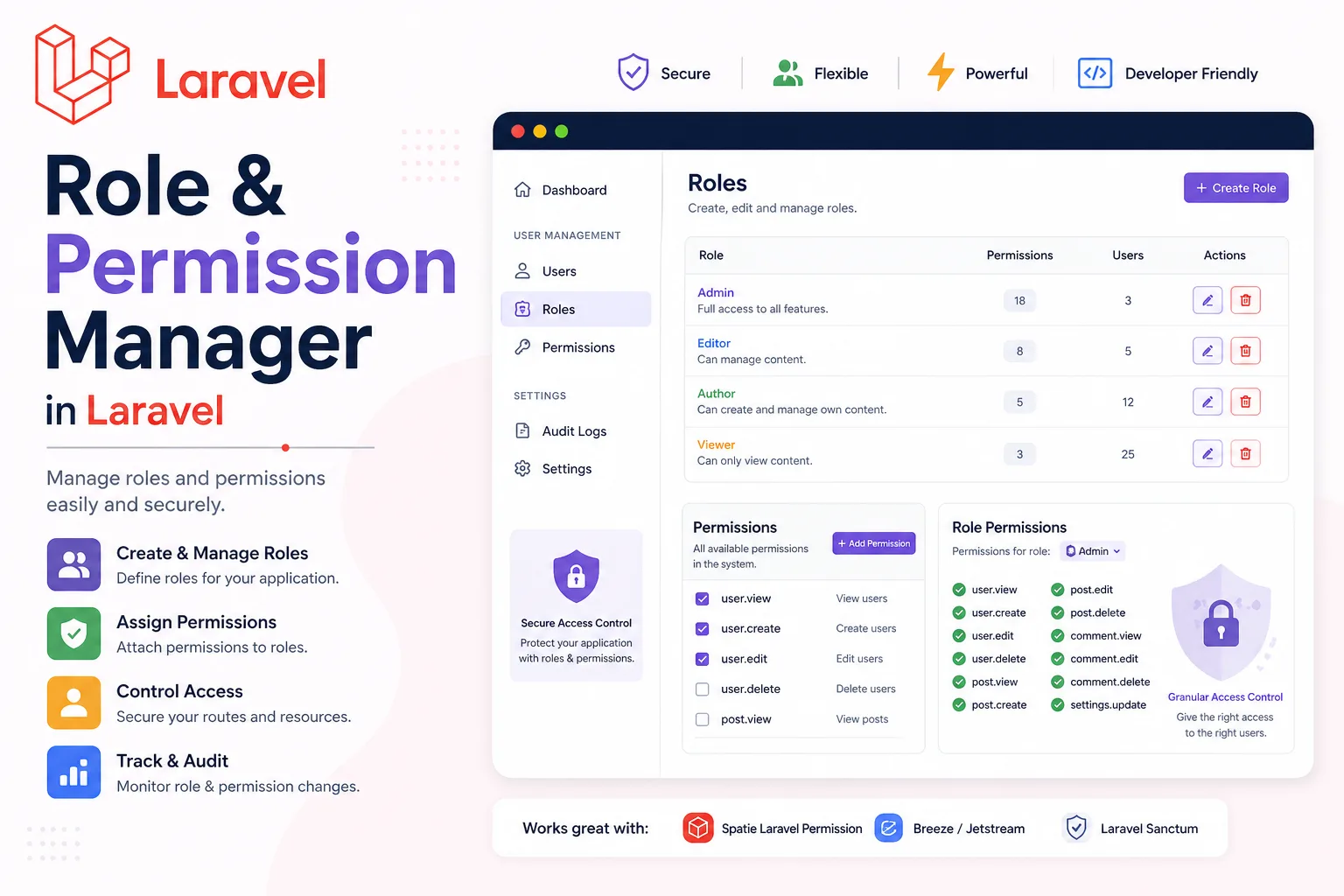
Implementing secure user authentication and authorization from scratch can be a daunting and error-prone task. Laravel simplifies this significantly by providing robust, pre-built solutions. With a few simple commands, you can scaffold an entire authentication system, including user registration, login, password reset, and email verification. Authorization features (gates and policies) allow you to easily define user roles and permissions, ensuring users only access what they're allowed to see or do, bolstering your application's security posture effortlessly.
Queues, Events, and Notifications
For modern web applications, handling long-running tasks asynchronously is crucial for maintaining responsiveness. Laravel's unified API for queues allows you to defer the processing of time-consuming tasks (like sending emails, processing images, crunching large data sets, or generating reports) to the background, significantly improving the user experience.
Events provide a simple observer implementation, allowing you to subscribe and listen for various events that occur in your application, enabling loosely coupled and event-driven architectures.
Notifications offer a clean, expressive way to send notifications across a variety of delivery channels (email, SMS, Slack, database, and more) from your application, centralizing your communication logic.
Robust Testing Capabilities
Laravel takes testing seriously, providing robust tools for both unit and feature testing right out of the box. Its integrated testing features allow developers to write expressive tests that simulate user behavior and interact with your application's database and services, ensuring the application functions as expected. This strong emphasis on testing encourages a test-driven development (TDD) approach, leading to more stable, reliable, and bug-free applications. Laravel's fluent API makes writing tests almost as enjoyable as writing the application itself.
Extensive Ecosystem & Community
Beyond its core features, Laravel benefits from a thriving ecosystem of official and third-party packages that extend its functionality. Projects like Laravel Forge (server provisioning and deployment), Laravel Nova (beautiful admin panel), Laravel Vapor (serverless deployment), and Laracasts (high-quality video tutorials) significantly enhance the developer experience. The large and active community, alongside comprehensive documentation, ensures ample support, resources, and continuous improvement, making it easier for developers to find solutions and best practices.
Why Laravel Stands Out in the Crowd
Choosing a framework is a significant decision that impacts project timelines, maintainability, and scalability. Laravel's enduring popularity stems from several compelling advantages:
- Speed of Development: With its rich set of features, Artisan CLI, and clear structure, Laravel significantly reduces development time, allowing teams to deliver projects faster and iterate more quickly.
- Maintainability: The MVC architecture, clean code, consistent conventions, and emphasis on best practices make Laravel applications easier to understand, maintain, and debug over time, even with growing complexity.
- Scalability: Laravel is designed to scale. Its queue system, robust caching integrations, and support for various database systems and cloud services make it suitable for applications that need to handle high traffic and growing data volumes gracefully.
- Security Features: Laravel comes with built-in protections against common web vulnerabilities like SQL injection, cross-site scripting (XSS), cross-site request forgery (CSRF), and manages password hashing securely, bolstering application security from the ground up.
- Developer Experience (DX): Laravel's elegant syntax, comprehensive documentation, developer-friendly tools, and supportive community contribute to a superior developer experience, making coding enjoyable, productive, and less frustrating.
What Can You Build with Laravel? Practical Use Cases
Laravel's versatility makes it suitable for a vast array of web projects, from simple blogs to complex enterprise solutions. Its adaptability allows developers to tackle diverse challenges:
- Custom CRM/CMS Systems: Tailored content management or customer relationship management platforms that precisely fit business needs.
- E-commerce Platforms: Robust online stores with complex product catalogs, inventory management, secure payment integrations, and personalized user experiences.
- SaaS Applications: Subscription-based software as a service products with multi-tenancy features, user management, and scalable infrastructure.
- APIs for Mobile Apps: Powerful backend APIs that serve data and handle logic for iOS, Android, and other frontend applications, ensuring seamless integration.
- Enterprise-level Applications: Large-scale business applications requiring high performance, intricate business logic, and integration with existing systems.
- Social Networking Sites: Platforms that manage user interactions, profiles, content sharing, notifications, and real-time updates.
Getting Started with Laravel: Your First Steps
Embarking on your Laravel journey is straightforward. The primary requirements are a PHP environment (version 8.1 or higher is recommended) and Composer, the PHP dependency manager. Once Composer is installed, you can create a new Laravel project with a single command: composer create-project laravel/laravel my-new-app. This command sets up a fully functional Laravel application skeleton. From there, dive into the official documentation at laravel.com/docs, explore the rich video tutorials on Laracasts, and start building! The learning curve is gentle for those familiar with PHP, and the rewards in terms of productivity and satisfaction are immense.
The Future is Bright with Laravel
Laravel isn't just a trend; it's a foundational framework that continues to evolve and adapt to the ever-changing web landscape. With a strong development team led by Taylor Otwell, a vibrant and supportive community, and a commitment to modern web standards and performance, Laravel remains a cutting-edge choice for building high-quality, maintainable, and scalable web applications. It simplifies complexity, enhances productivity, and ultimately, helps "web artisans" bring their digital visions to life with elegance and efficiency, ensuring projects built today will be robust and relevant for years to come.
In conclusion, if you're looking for a robust, developer-friendly, and feature-rich PHP framework to power your next web project, Laravel stands as a prime candidate. Its blend of elegance, power, and a supportive ecosystem makes it an invaluable tool in the modern web developer's arsenal, transforming the way we build the web.







All Rights Reserved © 2026