

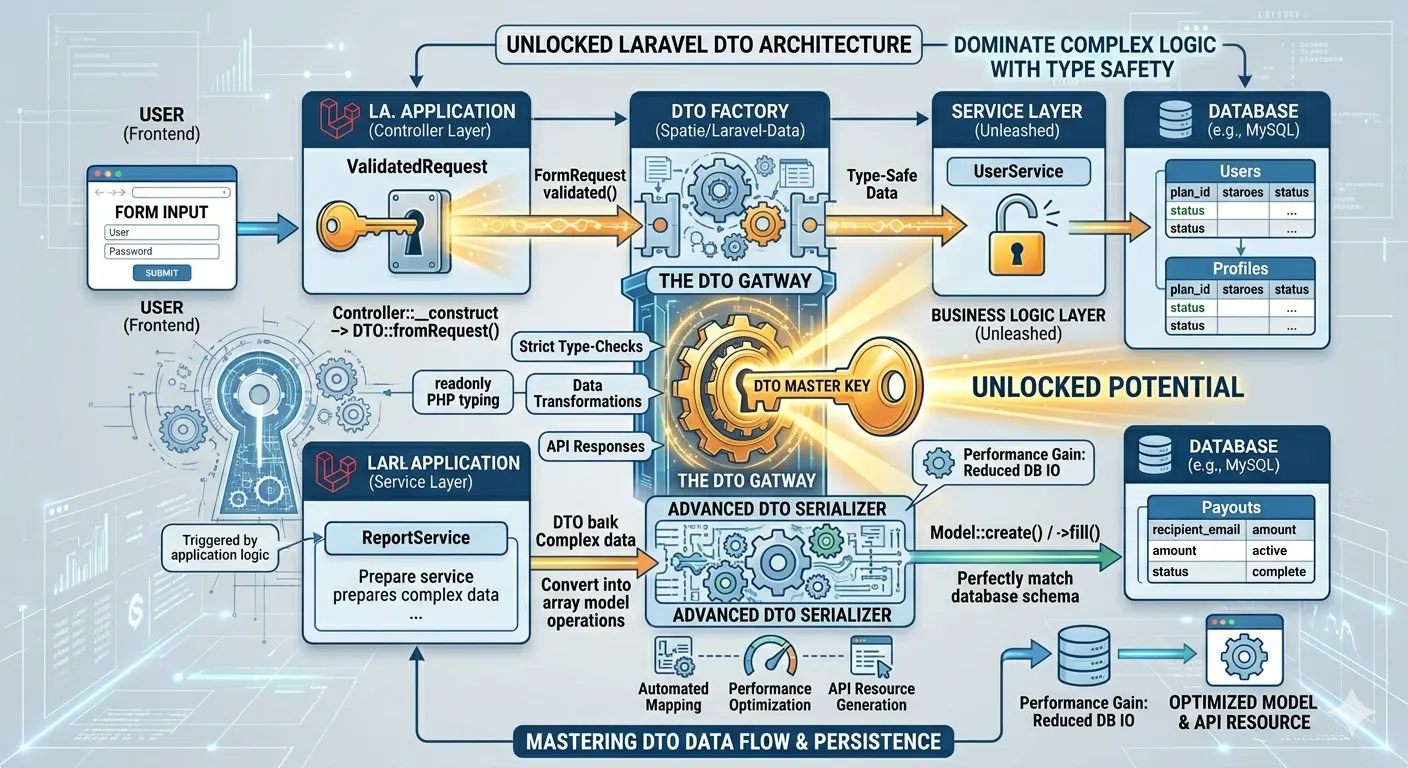
Unlock Laravel's Full Potential: Mastering Data Transfer Objects (DTOs)
As Laravel developers, we strive for elegant, maintainable, and scalable applications. Often, in the pursuit of rapid development, we might find ourselves passing raw request data directly into services or even relying heavily on Eloquent models to handle both persistence and data representation across different layers. While convenient for smaller projects, this approach can quickly lead to tightly coupled code, reduced readability, and increased complexity as your application grows.
Enter Data Transfer Objects (DTOs). These unsung heroes of clean architecture offer a powerful solution to structure and manage data flow within your Laravel applications, transforming messy data handling into a streamlined, type-safe, and highly maintainable process. If you're looking to elevate your Laravel development beyond the basics, understanding and implementing DTOs is a crucial step.
What Exactly Are Data Transfer Objects (DTOs)?
At their core, a Data Transfer Object (DTO) is a simple, plain PHP object designed to encapsulate data for transfer between different layers of an application. Think of it as a specialized courier: its sole job is to carry data from one point to another without containing any business logic or behavior.
Key characteristics of DTOs include:
- Pure Data Containers: They hold properties representing a specific set of data.
- No Business Logic: DTOs should not contain methods that perform computations, database interactions, or complex decision-making.
- Type Safety: By defining property types, DTOs provide explicit contracts for the data they carry, improving code reliability and IDE support.
- Immutability (Recommended): Often, DTOs are designed to be immutable, meaning their state cannot be changed once created. This ensures data integrity as it travels through your application.
The Problem DTOs Solve in Laravel Development
Consider a typical Laravel application without DTOs:
- Fat Controllers: Your controller might directly validate incoming request data, then pass an entire
Illuminate\Http\Requestobject or a raw array to a service layer. The service then has to parse and extract the relevant data, often duplicating validation or transformation logic. - Implicit Data Contracts: When a service method accepts a generic
array $data, it's not immediately clear what keys are expected or their types. This lack of explicit contract can lead to runtime errors and makes refactoring difficult. - Tight Coupling with Eloquent: Using Eloquent models directly for API responses or input can expose internal database schema details that shouldn't be part of your public API contract. It also ties your presentation layer directly to your persistence layer.
- Difficult Testing: Testing services that rely on a full
Requestobject can be cumbersome, requiring extensive mocking. - Reduced Readability & Maintainability: Over time, code becomes harder to understand and maintain when data structures are inconsistent or poorly defined.
DTOs address these issues by creating a clear, explicit, and type-safe boundary for data exchange.
Benefits of Adopting DTOs in Your Laravel Project
Integrating DTOs into your Laravel workflow offers a multitude of advantages:
- Clearer API Contracts: DTOs define exactly what data is expected as input and what data will be returned as output, making your APIs more predictable and easier to consume.
- Enhanced Type Safety and Validation: With typed properties, your IDE provides excellent auto-completion and static analysis tools can catch errors early. Furthermore, DTOs can be combined with Laravel's validation or even include basic validation rules themselves, ensuring data integrity at the entry point to your business logic.
- Decoupling Application Layers: DTOs act as a buffer. Your controllers don't need to know how data is persisted, and your services don't need to know the specifics of the HTTP request. This separation of concerns fosters a cleaner, more modular architecture.
- Improved Readability and Maintainability: Code that uses DTOs is often self-documenting. A quick glance at a DTO class tells you exactly what data it contains, making it easier for new developers to onboard and for existing team members to understand complex flows.
- Simplified Testing: Services that accept DTOs are far easier to test. Instead of mocking an entire
Requestobject, you simply create an instance of your DTO with the necessary test data. - Reduced Exposure of Internal Details: When returning data via an API, you can map your Eloquent models to an output DTO, exposing only the fields relevant to the client, without revealing your database structure.
- Immutability: By making DTO properties
readonly(PHP 8.1+) and setting values only in the constructor, you ensure that the data object remains consistent once created, preventing accidental modifications.
Implementing DTOs in Laravel: A Practical Approach
Let's walk through a simple example of how to implement DTOs for handling user creation in Laravel.
1. Define Your DTO Class
Create a new directory, e.g., app/DataTransferObjects, and define your DTO.
<?php

namespace App\DataTransferObjects;

use Illuminate\Http\Request;
use JsonSerializable;

class CreateUserDTO implements JsonSerializable
{
    public function __construct(
        public readonly string $name,
        public readonly string $email,
        public readonly string $password,
        public readonly ?string $bio = null,
    ) {}

    public static function fromRequest(Request $request): self
    {
        return new self(
            name: $request->string('name')->toString(),
            email: $request->string('email')->toString(),
            password: $request->string('password')->toString(),
            bio: $request->string('bio')->toString() ?? null,
        );
    }

    public function toArray(): array
    {
        return [
            'name' => $this->name,
            'email' => $this->email,
            'password' => $this->password, // Be cautious with passwords in DTOs, usually for input only
            'bio' => $this->bio,
        ];
    }

    public function jsonSerialize(): array
    {
        return $this->toArray();
    }
}
In this DTO:
- We're using PHP 8.1+ constructor property promotion and
readonlyproperties for immutability. - The
fromRequeststatic method provides a convenient way to instantiate the DTO directly from an incomingRequestobject. This acts as a factory. toArray()andjsonSerialize()methods are useful for converting the DTO into an array or JSON, especially if you plan to use it as an API response.
2. Integrate with a Form Request for Validation
While DTOs provide structure, Laravel's Form Requests are still excellent for handling validation.
<?php

namespace App\Http\Requests;

use Illuminate\Foundation\Http\FormRequest;

class StoreUserRequest extends FormRequest
{
    public function authorize(): bool
    {
        return true; // Or apply authorization logic
    }

    public function rules(): array
    {
        return [
            'name' => ['required', 'string', 'max:255'],
            'email' => ['required', 'string', 'email', 'max:255', 'unique:users'],
            'password' => ['required', 'string', 'min:8'],
            'bio' => ['nullable', 'string', 'max:1000'],
        ];
    }
}
3. Use the DTO in Your Controller
<?php

namespace App\Http\Controllers;

use App\DataTransferObjects\CreateUserDTO;
use App\Http\Requests\StoreUserRequest;
use App\Services\UserService;
use Illuminate\Http\JsonResponse;

class UserController extends Controller
{
    public function __construct(
        protected UserService $userService
    ) {}

    public function store(StoreUserRequest $request): JsonResponse
    {
        // The request has already been validated by StoreUserRequest
        $dto = CreateUserDTO::fromRequest($request);

        $user = $this->userService->create($dto);

        return response()->json([
            'message' => 'User created successfully',
            'user' => $user->only(['id', 'name', 'email'])
        ], 201);
    }
}
Notice how clean the controller is. It validates the request, maps the validated data into a DTO, and then passes the DTO to the service. The controller doesn't need to know how the user is created, only that it gets a CreateUserDTO to facilitate the process.
4. Consume the DTO in Your Service Layer
<?php

namespace App\Services;

use App\DataTransferObjects\CreateUserDTO;
use App\Models\User;
use Illuminate\Support\Facades\Hash;

class UserService
{
    public function create(CreateUserDTO $dto): User
    {
        $user = User::create([
            'name' => $dto->name,
            'email' => $dto->email,
            'password' => Hash::make($dto->password), // Hash the password here
            'bio' => $dto->bio,
        ]);

        return $user;
    }
}
The UserService now has a clear, type-hinted contract for its create method. It explicitly expects a CreateUserDTO, ensuring that it always receives the correct structure of data it needs, without direct dependency on the HTTP request.
When to Use DTOs (and When Not To)
DTOs are a powerful tool, but like any architectural pattern, they aren't a silver bullet for every situation. Consider these guidelines:
Use DTOs When:
- Building APIs: Both for input payloads (request DTOs) and standardized output responses (response DTOs).
- Complex Forms: When a form has many fields and requires specific data transformations before hitting the database.
- Inter-Service Communication: If you have multiple services or modules that need to exchange data.
- Command/Query Bus Patterns: DTOs are excellent for representing commands or queries.
- Clean Architecture Layers: To explicitly define data contracts between application layers (e.g., presentation to application, application to domain).
Avoid DTOs When:
- Very Simple Operations: For basic CRUD operations with minimal data, a direct
request()->validate()and Eloquent interaction might suffice. Don't over-engineer. - Internal Helper Functions: If a function only needs a few basic scalar values, passing them directly might be clearer than creating a dedicated DTO.
- Direct Database Interaction in Small Scripts: For quick scripts or one-off tasks where the overhead of a DTO isn't justified.
Leveraging Dedicated DTO Packages (e.g., Spatie's Laravel-DTO)
While rolling your own DTOs is straightforward, packages like Spatie's Laravel-DTO can significantly enhance your experience. They provide features like:
- Automatic data mapping from arrays or requests.
- Validation integration (including nested DTOs).
- Built-in immutability.
- Support for default values and nullable properties.
If you find yourself creating many DTOs and want to streamline the process, exploring such packages is highly recommended.
Best Practices for DTOs in Laravel
- Keep Them Lean: DTOs should only contain data, not business logic.
- Make Them Immutable: Whenever possible, use
readonlyproperties and set them via the constructor. - Clear Naming Conventions: Name DTOs descriptively, indicating their purpose (e.g.,
CreateUserDTO,UserProfileDTO,OrderLineItemDTO). - Separate Input/Output DTOs: Often, the data you receive from a request differs from the data you send back as a response. Use distinct DTOs for each.
- Organize Them: Keep your DTOs in a dedicated directory like
app/DataTransferObjects.
Conclusion
Data Transfer Objects are more than just a coding pattern; they are a mindset for structuring data and building resilient, clean architectures in Laravel. By explicitly defining your data contracts, you'll gain enhanced type safety, clearer code, easier testing, and significantly improved maintainability.
While they introduce a small amount of boilerplate, the long-term benefits in larger, more complex applications far outweigh this initial effort. Embrace DTOs in your next Laravel project and experience the power of truly clean, decoupled data management.
Other Categories









All Rights Reserved © 2026